

Utah Structural 30 PDH Discount Package 3
Repair and Retrofit of Fatigue Cracks in Steel Bridges (S09-001)
Determining the Cost/Benefit of Routine Maintenance Cleaning on Steel Bridges (S03-024)
Guide for In-Place Treatment of Wood in Historic Covered and Modern Bridges (S04-020)
Building a Safe Room for Your Home or Small Business (S04-025)
Strength Design For Reinforced Concrete Hydraulic Structures (S03-022)
Installing Seismic Restraints for Mechanical Equipment (S05-008)
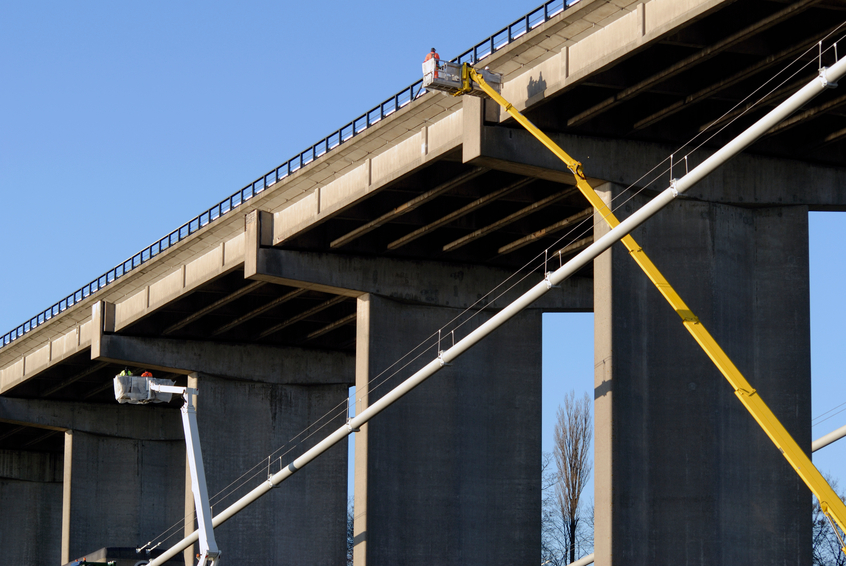
This online engineering PDH course provides the practicing engineer with the background required to understand and use the design rules for fatigue resistance that are currently a standard part of design codes for fabricated steel structures.
Fatigue in metals is the process of initiation and growth of cracks under the action of repetitive tensile loading. If crack growth is allowed to go on long enough, failure of the member can result when the uncracked cross-section is sufficiently reduced such that the member can no longer carry the internal forces from the crack which extends in an unstable mode. The fatigue process can take place at stress levels that are substantially less than those associated with failure under static loading conditions. The usual condition that produces fatigue cracking is the application of a large number of load cycles.
This 2 PDH online course is applicable to civil and structural engineers and professionals who are interested in learning more about fatigue and the different design standards for fabricated steel structures.
This PE continuing education course is intended to provide you with the following specific knowledge and skills:
- Gaining an overview and a historical perspective of fatigue in metals
- Familiarizing with crack growth and its underlying conditions
- Learning about the flaws in fabricated steel structures
- Understanding the load-induced and distortion-induced fatigue
- Understanding the finite/infinite life design
- Knowing about fracture control and the AASHTO provisions and specifications
In this professional engineering CEU course, you need to review the course document titled, “Steel Bridges: Design for Fatigue”, which is based on the U.S. Department of Transportation Federal Highway Administration document, “Steel Bridge Design Handbook: Design for Fatigue”, Publication No. FHWA-HIF-16-002 - Vol. 12, dated December 2015.
Upon successful completion of the quiz, print your Certificate of Completion instantly. (Note: if you are paying by check or money order, you will be able to print it after we receive your payment.) For your convenience, we will also email it to you. Please note that you can log in to your account at any time to access and print your Certificate of Completion.
This online engineering PDH course delivers the best practices for repair and retrofit of fatigue cracks in steel bridges.
This course is also a guide for owners and consulting engineers to use for design and detailing of repairs and retrofits for fatigue cracks. It should be used in conjunction with existing specifications, codes, and engineering judgment. In addition to designing and executing the repairs and/or retrofits, there are numerous other steps involved in the inspection and assessment of a cracked bridge member.
When cracks are discovered in bridge elements (members or connections) in service, fatigue is usually the cause. Fatigue is the formation of a crack due to cyclic service loads. Fracture may be defined as rupture in tension or rapid extension of a crack, leading to gross deformation, loss of function or serviceability, or complete separation of the component. Periodic in-service inspection provides an opportunity to assure safety by detecting cracks before they grow to a critical size. The Federal Highway Administration has mandated a twenty-four month inspection interval for all highway bridges located on public roads which is intended to detect problems before they become critical to structural performance.
This 9 PDH online course is applicable to civil and structural engineers as well as consulting engineers who are interested in design and detailing of repairs and retrofits for fatigue cracks.
This PE continuing education course is intended to provide you with the following specific knowledge and skills:
- Familiarizing with the definition of fatigue and fracture in steel bridges
- Developing a fracture control plan and carrying inspections
- Selecting the proper repair and retrofit strategy
- Assessing fatigue effect using several approaches such as nominal stress approach, local stress approach, fracture mechanics approach, etc.
- Understanding the repair and retrofit methods such as surface treatments, impact treatments, etc.
- Identifying out of plane distortion due to secondary stresses
- Learning the repair methods specific to out-of-plane distortion such as: hole drilling, web gap softening, web gap stiffening, etc.
- Knowing the repair methods by loads induced fatigue
Upon successful completion of the quiz, print your Certificate of Completion instantly. (Note: if you are paying by check or money order, you will be able to print it after we receive your payment.) For your convenience, we will also email it to you. Please note that you can log in to your account at any time to access and print your Certificate of Completion.
This online engineering PDH course aims at identifying the key variables necessary in estimating the impact of regular washing of steel bridges on the paint and service life, recommending methods for recording data in order to most effectively estimate the benefits of bridge washing, and developing a framework to assess the impact of bridge washing on paint life.
Thirty years ago, when the environmental rules changed, the WSDOT stopped annual cleaning of steel truss bridges. Some cleaning was done after this time only to assist inspection crews or to determine what the cost would be to hand clean a steel truss bridge. WSDOT is investigating the feasibility of an annual steel truss bridge washing program. A pilot study was implemented in 2011 that will help to determine the benefits and environmental impacts of such a program.
This work builds on the pilot study to identify current bridge washing practices around the country and to select the measurements necessary to determine whether more regular washing has positive cost benefits. The research summarized in this course is a first step towards understanding and quantifying the benefits of a more regular bridge washing program on paint life and corrosion.
This 3 PDH online course is applicable to civil and structural engineers who are interested in assessing the impact of bridge washing on paint and service life, estimating the benefits of bridge washing, and improving the maintenance of steel bridges.
This PE continuing education course is intended to provide you with the following specific knowledge and skills:
- Familiarizing with the pilot bridge washing program, the conducted studies and the yielded results
- Gaining a general overview on the research and literature review concerning bridge maintenance
- Learning about the nationwide survey on bridge washing programs, and the responses in different States
- Exploring the bridge washing programs in different States including Iowa, Alaska, Kentucky, New York, New Hampshire, Missouri, Indiana
- Identifying the impact of regular bridge washing programs on paint life and corrosion
Upon successful completion of the quiz, print your Certificate of Completion instantly. (Note: if you are paying by check or money order, you will be able to print it after we receive your payment.) For your convenience, we will also email it to you. Please note that you can log in to your account at any time to access and print your Certificate of Completion.

This online engineering PDH course provides basic information on procedures for selecting and applying in-place treatments to bridges to prevent or arrest degradation, and discusses different approaches for minimizing damage caused by fire.
Wooden bridges have a long history of use throughout the world, and like bridges made of other materials, the service life of wooden bridges can be enhanced through proper construction, inspection, and maintenance. Wooden bridges, whether historic covered bridges or current highway timber bridges, can be vulnerable to damage from biodeterioration, fire or biodegradation. Biodeterioration is minimized through design and construction practices, and in the case of modern timber bridges, through pressure treatment of the timbers with wood preservatives. However, over time, many bridges need maintenance in order to prevent degradation and to minimize any damage caused by fire.
In order to maintain wood bridges, different methods, procedures and treatments are used. These include; in-place treatments, surface-applied liquid treatments, paste surface treatments, internal treatments, and fire retardants, all of which are discussed in this course.
This 4 PDH online course is mainly intended for structural engineers and others who are interested in learning more about the different methods of applying treatments to bridges and understanding the approaches for minimizing damage caused by fire.
This PE continuing education course is intended to provide you with the following specific knowledge and skills:
- Familiarizing with the causes and problem areas for biodegradation in wooden bridges, the effects of climate and the role of wood structure
- Learning about the different types of supplemental treatments including water-diffusible preservatives, non-diffusible liquid treatments and fumigants
- Gaining a general overview on the application and use of supplemental preservative treatments for covered bridges
- Understanding the use of supplemental fire-retardant treatments for covered bridges
- Exploring supplemental treatment concepts such as liquid surface treatments, paste surface treatments, and internal treatments
Upon successful completion of the quiz, print your Certificate of Completion instantly. (Note: if you are paying by check or money order, you will be able to print it after we receive your payment.) For your convenience, we will also email it to you. Please note that you can log in to your account at any time to access and print your Certificate of Completion.

This online engineering PDH course provides an overview of the importance of safe rooms, as well as their design and construction process.
Every year, tornadoes, hurricanes, and other extreme windstorms cause injury, death, and property damage worth billions of dollars in the United States. Even so, more and more people build homes in tornado- and hurricane-prone areas, possibly putting themselves into the path of such storms. Having a safe room for your home or small business can help provide near-absolute protection for you and your family or employees from injury or death caused by the dangerous forces of extreme winds.
This 4 PDH online course is applicable to structural engineers, design professionals, homeowners and other technical personnel who are interested in learning more about designing and building safe rooms.
This PE continuing education course is intended to provide you with the following specific knowledge and skills:
- Understanding the various natural hazards faced in the United States
- Learning how to determine whether a safe room is needed or not
- Knowing the different design options for safe rooms
- Familiarizing with the construction of safe rooms
- Learning about the various testimonies of people who have benefited from safe rooms
Upon successful completion of the quiz, print your Certificate of Completion instantly. (Note: if you are paying by check or money order, you will be able to print it after we receive your payment.) For your convenience, we will also email it to you. Please note that you can log in to your account at any time to access and print your Certificate of Completion.

This online engineering PDH course describes typical loads for the design of reinforced concrete hydraulic structures (RCHS) and provides detailed information on design procedures along with examples of their application.
Reinforced concrete hydraulic structures have very long service lives and are subject to different types of loads, severe climatic conditions and sometimes to chemically contaminated atmosphere. To ensure a satisfactory long term service and to provide a safe, reliable and cost effective hydraulic structures, industry design and construction standards should be adopted.
Satisfactory long-term service requires that the saturated concrete be highly resistant to deterioration due to daily or seasonal weather cycles and tidal fluctuations at coastal sites. The often relatively massive members of RCHS must have adequate density and impermeability, and must sustain minimal cracking for control of leakage and for control of corrosion of the reinforcement. Most RCHS are lightly reinforced structures (reinforcement ratios less than 1%) composed of thick walls and slabs that have limited ductility compared to the fully ductile behavior of reinforced concrete buildings (in which reinforcement ratios are typically 1% or greater).
This 3 PDH online course is applicable to civil and structural engineers who are interested in learning more about reinforced concrete hydraulic structures, its detailed design considerations and applications.
This PE continuing education course is intended to provide you with the following specific knowledge and skills:
- Familiarizing with the details of reinforcement in various members of hydraulic structures
- Familiarizing with the different designs of RCHS and examples of their applications
- Learning about members that are subjected to shear load effects
- Understanding the effect of combined flexural and axials loads on design parameters
- Knowing the strength and serviceability requirements of different structures
Upon successful completion of the quiz, print your Certificate of Completion instantly. (Note: if you are paying by check or money order, you will be able to print it after we receive your payment.) For your convenience, we will also email it to you. Please note that you can log in to your account at any time to access and print your Certificate of Completion.

This online engineering PDH course provides guidelines on how to attach mechanical equipment to a building to minimize earthquake damage. It presents examples of anchoring and using special devices called seismic restraint devices. These devices include vibration isolation systems, cable or strut suspension systems, roof attachment systems and steel shapes.
This 5 PDH online course is applicable to structural and mechanical engineers, architects, contractors, building professionals, and other technical personnel dealing with the planning, design and installation of mechanical equipment.
This PE continuing education course is intended to provide you with the following specific knowledge and skills:
- Identifying mechanical equipment and selecting the appropriate method for its installation
- Familiarizing with the different types of attachments
- Familiarizing with the various types of anchors
- Understanding the different methods of supporting control panels
- Understanding the various methods of attaching HVAC equipment to residential structures
- Learning how to design housekeeping pads for seismic measures
In thisprofessional engineering CEU course, you need to review the publication "Installing Seismic Restraints for Mechanical Equipment" (FEMA 412), published by the Federal Emergency Management Agency.
Upon successful completion of the quiz, print your Certificate of Completion instantly. (Note: if you are paying by check or money order, you will be able to print it after we receive your payment.) For your convenience, we will also email it to you. Please note that you can log in to your account at any time to access and print your Certificate of Completion.